License Plate Recognition Cameras for Parking Lots: What Actually Works
· Erik Short
Quick answers
- Why can't my existing parking lot camera read plates? It's mounted too high, too wide, and running a slow shutter at night — a plate is a tiny, retroreflective, moving target that needs its own dedicated camera aimed at one lane.
- What does a real LPR setup require? One camera per lane at a choke point, mounted roughly 4–8 feet high within about 15–30 degrees of head-on, a fast shutter, and IR illumination tuned so the plate doesn't blow out.
- Can one camera cover a whole parking lot and read plates? No. An overview camera and a plate camera are two different jobs, and trying to do both gets you neither.
- Does UniFi Protect do license plate recognition? Yes — Protect includes plate detection and license plate alerts on supported cameras, and it's genuinely good for entry and exit lanes on a single-property site.
- What breaks LPR in a Boise winter? Snow-packed and salt-filmed plates, low January sun angles right down the driveway, and slush spray coating the camera lens.
The call usually comes two days after something happened. A truck got into the back lot overnight and somebody's catalytic converter is gone, or a tenant's car got keyed, or a delivery driver clipped a bollard and left. The facilities manager pulls up the recorded video, finds the car, zooms in on the plate — and gets a rectangle of white mush.
Then they call us and say: "We need plate cameras."
Fair enough. Here's what that actually means, what it costs you in camera count, and what it will and won't do once it's up.
Why your current camera will never read a plate
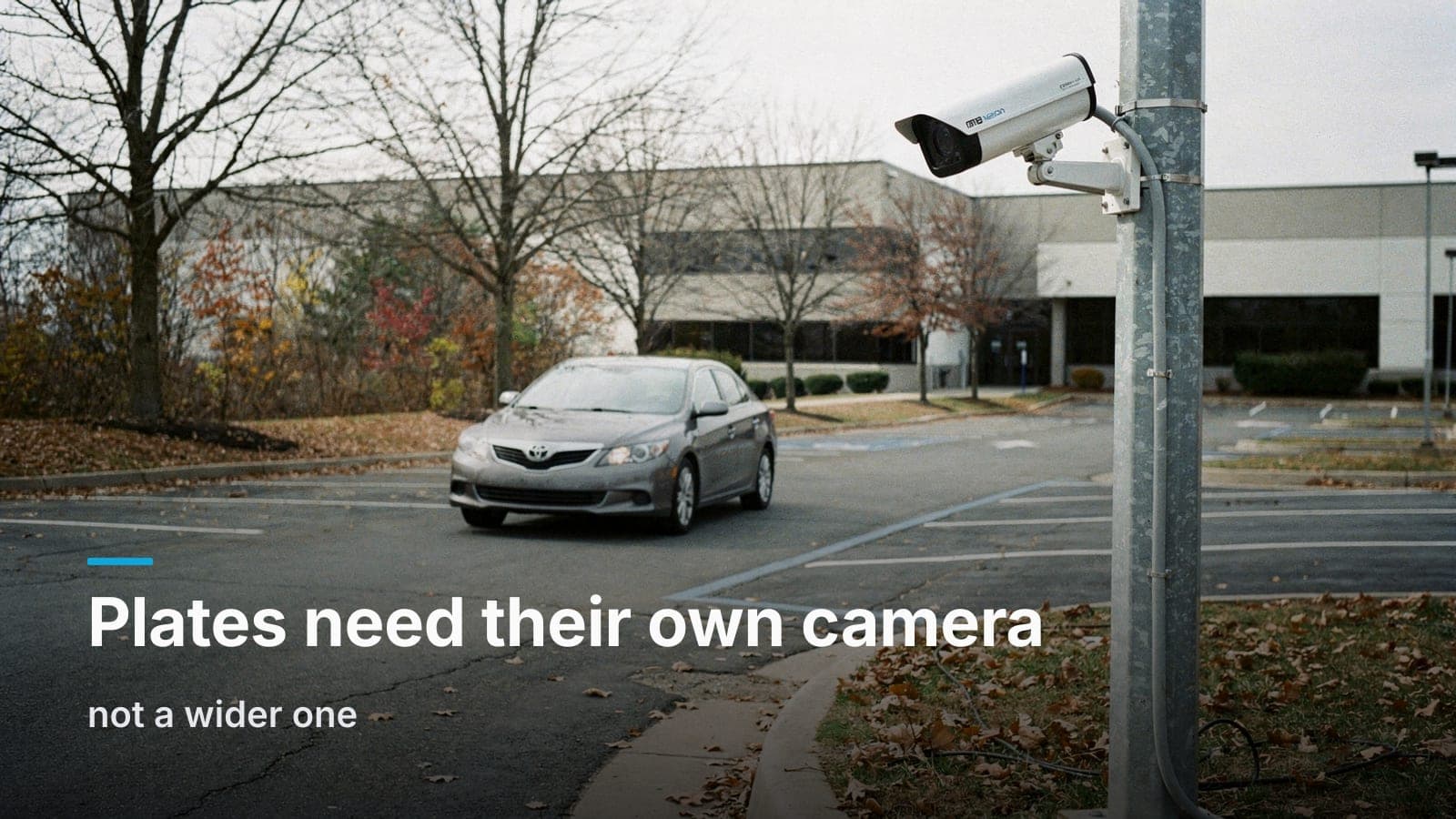
A parking lot overview camera is doing a completely different job than a license plate recognition camera. Four things are working against it:
Pixel density. Reading a plate reliably takes somewhere in the neighborhood of 60–80 pixels across the plate's width — call it a foot of real-world width mapped onto a meaningful chunk of sensor. A 4MP camera watching 120 feet of parking lot is spending maybe a dozen pixels on that plate. Zooming in later doesn't invent detail that was never recorded. This is the same math behind most of the placement mistakes we end up fixing — cameras mounted to see everything end up identifying nothing.
Angle. Plates are designed to be read from behind a car, near the same height as the plate. Mount a camera at 14 feet on a building corner and you're looking down at 40+ degrees. Characters compress, the plate frame shadows the top row, and the retroreflective coating bounces your IR straight back at the ground instead of at the lens. Past about 30 degrees off-axis, horizontal or vertical, accuracy falls off a cliff.
Shutter speed. This is the one people miss. At night, a normal camera drops its shutter to 1/30th of a second or slower to gather light. A car rolling into a lot at 10 mph covers about 6 inches in that time — the plate smears. An LPR camera runs a fast shutter (often 1/500 to 1/2000) and accepts a nearly black image of everything except the plate, because the plate is retroreflective and lights up under IR like a road sign.
Glare. Headlights. A camera set up to expose a whole scene will blow out completely when a pair of LED headlights swings toward it. The plate sits directly between those headlights. This is why a good plate image at night looks like a floating white rectangle in a void — that's not a failure, that's the design working.
So: a general camera exposed for the scene, wide, high, and slow, cannot also be a camera exposed for a retroreflective strip, narrow, low, and fast. Two cameras. Every time.
What a real LPR install looks like
One camera per lane, at a choke point
The whole strategy is to stop trying to read plates in the open lot and instead read every plate as it passes a place where cars must funnel single-file and slow down. Entrances. Exits. A gate. A ramp into a parking structure. A narrow drive aisle behind a building.
If your entrance is two lanes wide, that's two cameras — or one camera and a lane you accept you won't catch. If you have three driveways onto the property, that's three cameras minimum, and six if you want directional in/out.
That's the sticker shock moment for most facility managers. LPR is a per-lane cost, not a per-property cost.
Mounting height and geometry
Rules of thumb we work from on a site walk:
- Height: 4 to 8 feet at the capture point. Higher than that and you need more distance to keep the angle shallow.
- Vertical angle: under 30 degrees; under 20 is better.
- Horizontal angle: under 30 degrees off the vehicle's centerline. Aim down the lane, not across it.
- Capture distance: for a typical varifocal bullet, 15 to 50 feet works. Longer distances need more zoom and get fussier about vibration.
- Vehicle speed: under 20 mph at the capture point. If cars are moving faster, find a spot where they're not — right at the apron, at a speed hump, at a gate.
- Mount rigidity: a pole that flexes in Idaho wind will cost you reads. Short, stiff pole or a solid wall bracket. Not a light standard 20 feet up that sways.
Illumination
The plate needs its own light at night. Either the camera's integrated IR is tight enough to cover the capture zone, or you add a dedicated IR illuminator. What you're not doing is lighting the whole lot brighter and hoping. Ambient white light actually makes plate capture harder in some cases, because it lifts the background exposure and the camera stops isolating the plate.
Plan the lane, not the camera
The best LPR installs are decided at the site walk, standing in the driveway watching cars come in, not on a drawing. Where do people actually slow down? Which way does the sun sit at 8 a.m. in December? Is there a mailbox cluster or a landscape berm in the sight line? Can we get conduit and power to that spot without trenching the whole entrance?
That last one matters more than people expect. Entrance cameras are usually the farthest point from your network closet. You're looking at a run over 328 feet, which means a fiber run and a small outdoor enclosure with a media converter and a PoE injector, or a properly grounded copper run with surge protection at both ends. It's a real scope item. We cover the general shape of that in what commercial camera installation actually costs in Boise, and entrance LPR sits at the higher end of it for exactly this reason.
UniFi Protect LPR vs. dedicated LPR platforms
We install UniFi across most of our camera projects, and Protect does include license plate detection — it reads plates on supported cameras, logs them with the clip, and can fire alerts on a plate you've added to a list. For a single property that wants to know which vehicles come and go, it works well and there's no per-camera plate-reading subscription stacked on top.
Where it's honestly not the right tool: multi-site plate databases, hotlist integration with law enforcement feeds, parking enforcement and permit billing, or high-speed roadway capture. Purpose-built LPR vendors have spent years on those problems and it shows.
| UniFi Protect LPR | Dedicated LPR platform (Genetec, Vigilant, purpose-built ANPR) | Parking-management LPR | |
|---|---|---|---|
| Best for | Single site, entry/exit lanes, visitor and tenant vehicle logging | Multi-site, hotlists, investigations, high vehicle volume | Permit enforcement, paid parking, tenant validation |
| Cost shape | One-time hardware, no per-camera plate subscription | Hardware plus per-camera or per-server licensing | Per-lane hardware plus ongoing service/subscription |
| Ownership | Hardware and footage owned outright, on-prem | Varies by vendor | Usually vendor-managed |
| Speed tolerance | Low-speed choke points | Higher speeds, roadway-grade options | Low-speed gate/lane |
| Who manages it | Your team, in one app | Often a dedicated security operator | Vendor or property management portal |
If you own one building and you want a searchable record of what drove in the back gate at 2 a.m., Protect is plenty. If you run twelve properties and need a plate search across all of them with an audit trail, buy the dedicated platform and don't feel bad about it. We'll tell you that on the site walk rather than jamming the wrong tool into your lot.
Same logic applies to where the footage lives — we broke that down in NVR vs. cloud storage for business cameras, and LPR doesn't change the answer much, except that plate metadata makes on-prem search a lot more useful than scrubbing timeline.
Honest expectations
Here's what I tell every facilities manager before we quote a plate camera:
You will get plates at the entrance. You will not get plates across the lot. If a car parks in row F and somebody breaks into it, your LPR camera at the driveway tells you which vehicles entered in that window. It doesn't read the plate of the car sitting in row F. That's still a job for well-placed overview cameras and good lighting.
Accuracy is a percentage, not a guarantee. A well-designed lane on dry pavement in daylight reads very well. Add a dirty plate, a trailer hitch ball blocking a character, a plate frame from the dealership covering the state name, a paper temp tag, or a lifted truck with the plate mounted off-center, and you'll miss some. Nobody hits 100%.
Plate reads are evidence support, not a deterrent. A visible camera at the entrance changes behavior a little. The plate log is mostly valuable after, when you can hand a police report a list of five plates instead of a blurry silhouette.
Combine it with access control. On properties with a gate, the most useful setup we build isn't LPR alone — it's LPR plus credentialed gate access, so a plate read pairs with a badge or code event. Now you know both the vehicle and who opened the gate. If you're already weighing badges versus keys for the building itself, that trade-off piece is worth a read.
The Boise winter footnote
Treasure Valley conditions do a few specific things to plate cameras that a spec sheet won't warn you about.
Salt and magnesium chloride film. By mid-January, half the plates on Fairview are coated in gray road film. A dirty plate loses contrast and, worse, loses retroreflectivity — the thing the whole night-time strategy depends on. Expect a measurable accuracy dip from December through February. Nothing to fix; just know it's coming.
Snow-packed plates. Slush packs into the recessed characters and the reader sees a flat white rectangle. Same deal — it's physics, not a bad install.
Low sun angle. This one is fixable and it's a real reason to do the site walk in person. In December the sun sits low in the southern sky all day. If your entrance faces roughly south or southwest, there will be a couple of hours where the sun is aimed straight into the camera and you get nothing but flare. Shifting the camera to the other side of the lane, adding a longer weather shroud, or moving the capture point 20 feet up the drive usually solves it. Finding out in January that it doesn't work does not.
Lens contamination. A camera mounted low at an entrance is at exactly the height that gets sprayed by passing tires. A shroud helps. So does a quarterly wipe-down — it belongs on the same short maintenance checklist as checking your recorder drives and verifying retention. A lens with a film of dried slush on it will still show you a car. It will not show you a plate.
Fog on the valley floor. Those inversion weeks knock down contrast at any distance. Shorter capture distances ride it out better, which is one more argument for putting the camera close to the lane rather than zooming in from across the lot.
What I'd actually do if you called me tomorrow
- Walk the property and count the vehicle entry points. That number drives the whole budget.
- Stand at each one during a busy period and watch where cars slow down.
- Check the sun line, the sight line, and the path for conduit and fiber.
- Spec one LPR camera per lane you care about, plus keep or upgrade the overview cameras — they're a separate line item and they're still doing the heavy lifting for the rest of the lot.
- Hand over a fixed quote that separates "plate capture at the entrance" from "general parking lot coverage," so you can see exactly what you're paying for each.
The thing I want you to walk away with: plate cameras aren't a resolution upgrade. They're a different kind of camera doing a different job at a different place on your property. Budget for them that way and they'll work.
Frequently asked questions
Can LPR read plates on cars already parked in the lot?
Some systems will detect plates on stationary vehicles if the camera happens to have a clean, close, head-on view — but that's not what LPR is designed for and it won't scale across a lot. For parked-vehicle coverage you want overview cameras with enough pixel density to describe the car, not read the tag.
Do I need a gate for license plate recognition to be worth it?
No. Plenty of open lots get real value from a plate log at the driveway. A gate just makes the capture easier — cars are stopped, the geometry is fixed, and you can tie the read to an access event.
Will LPR work on Idaho's specialty and vanity plates?
Mostly, but they're harder. Graphic-heavy specialty plates reduce character contrast and some readers struggle with them, especially at night. Standard plates read best, and a plate frame covering the top or bottom edge causes more misses than the plate design itself.
How much storage does an LPR camera add?
Less than you'd think for the video, since these cameras are usually narrow-field and lower resolution than an 8MP overview. The plate metadata itself is tiny. Where retention matters is being able to search back 30 or 60 days after an incident nobody reported at the time — that's a recorder sizing question, not an LPR question.
Can I add LPR to the camera system I already have?
Usually, if the recorder and platform support it and there's a path for power and data to the entrance. The existing cameras won't become plate readers, but adding a dedicated LPR camera to a healthy system is a normal, contained project.
If you've had a lot incident and you're trying to figure out what plate coverage would actually take on your property, request a site walk — we'll stand in the driveway with you and give you a fixed quote.