What Drives Cat6 Drop Cost in Boise Offices
· Erik Short
Quick answers
- What is a "drop"? One cable run from the network rack to one outlet location, terminated on both ends, tested, and labeled.
- What moves the price most? Ceiling type (open grid vs. hard lid), plenum rating, run length, how many drops are on one mobilization, and whether you need after-hours access.
- Should I buy per-drop or time-and-materials? Per-drop for standard office work with a known scope; T&M only for exploratory work in an unknown building.
- What should the quote itemize? Drop count, cable type and rating, jack/faceplate hardware, rack and patch panel work, testing and certification, labeling, and firestopping.
- Why is one bid way cheaper? Usually because it leaves out testing, labeling, firestop, plenum cable, or the rack buildout, not because the installer found a magic discount.
I'm not going to post a per-drop number on this page. Any integrator who gives you one over the phone before seeing the building is guessing, and the guess is going to be either padded to cover the worst case or low enough that the change orders do the real pricing later. What I can do is tell you exactly what makes one drop cost twice what another drop costs in the same square footage, so when you line up three bids in Boise or Meridian you can actually tell what you're comparing.
Why "cost per drop" is a real unit, and where it breaks
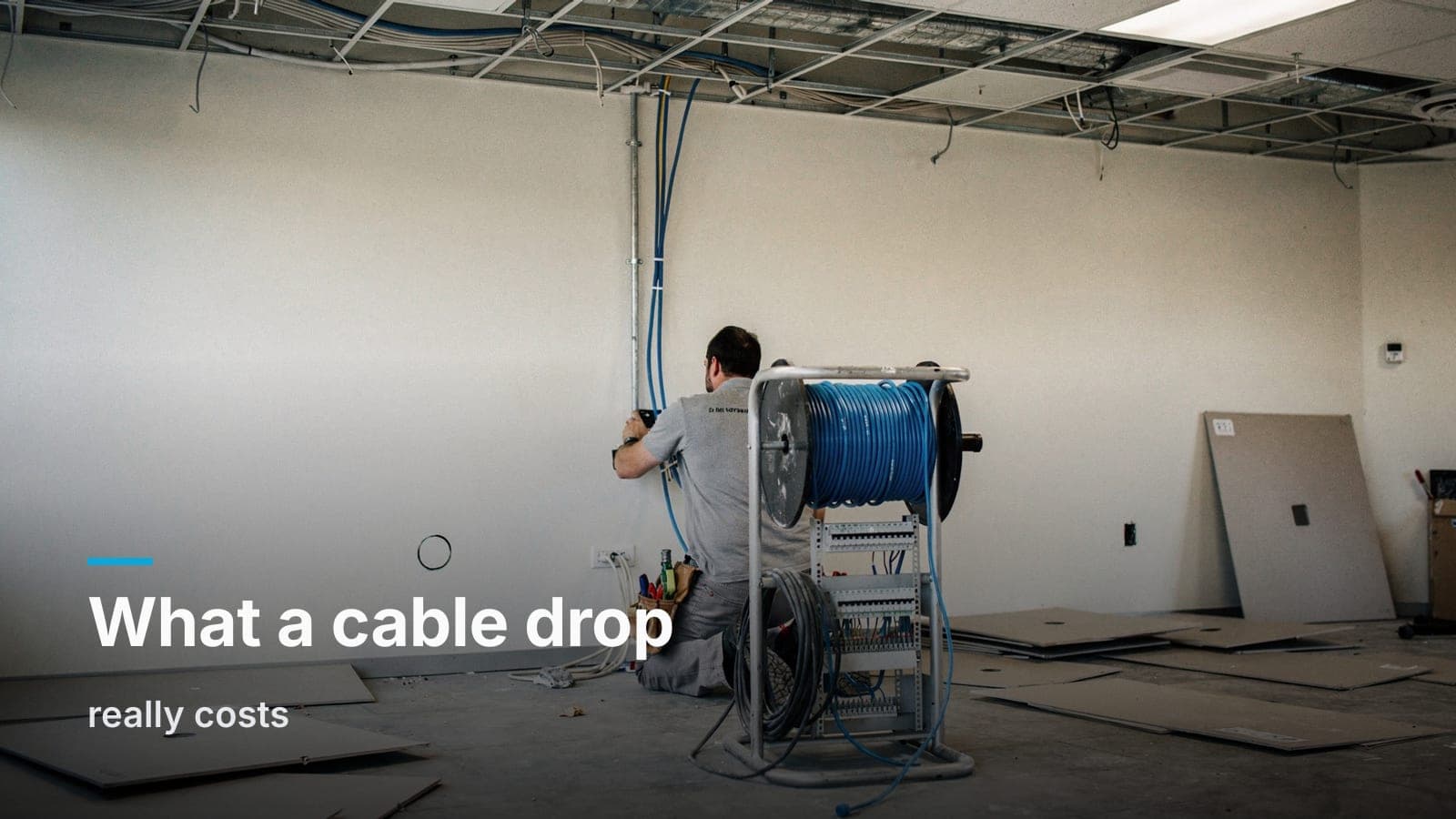
Structured cabling prices well per drop because, in a standard office, the work is repetitive. Same cable, same jack, same ceiling, same path back to the same rack. The second drop in a room costs less in labor than the first, and the twentieth costs less than the second, because the hard part (getting to the ceiling, getting the pathway established, setting up the rack side) is already paid for.
That's the whole logic of per-drop pricing: it averages the setup across the count. A fixed per-drop number from a site walk gives you a budget you can hand to your GC or your CFO without a running meter.
Where per-drop breaks down:
- Retrofits in buildings nobody has as-builts for. Old Garden City and downtown Boise spaces especially. We don't know what's above the lid until we open it.
- Scattered single drops. One drop on this floor, one in the back warehouse, one in the detached shop. Each is a mobilization, not a drop.
- Mixed media. A job that's 30 copper drops plus two fiber runs and a conduit bore under a sidewalk isn't a per-drop job. It's three jobs.
- Demo and remediation. Pulling out decades of abandoned cable is its own line item and should be priced that way.
For a normal tenant improvement or an office refresh, per-drop is the honest way to quote. For anything with unknowns, you want a fixed price on the known scope plus an hourly rate clearly stated for the unknowns, with your approval required before it's spent.
The six things that actually move the number
1. Ceiling type
This is the single biggest swing on commercial work.
Open grid (lay-in tile) or exposed structure is the cheap case. Pop a tile, run J-hooks or bridle rings, pull cable, done. A warehouse with open bar joist is even faster, assuming you can get a lift in there.
Hard lid (drywall ceiling, no access) is where the price climbs. Every drop now needs fishing, access cuts, or a new pathway. You're also now coordinating with a drywall patcher and a painter, and that trade work either lands on your bid or on somebody else's. Medical suites and remodeled retail are full of hard lid.
Open-to-deck with exposed architectural ceilings is its own category. The cable is visible, so the client cares what it looks like. That means surface raceway, matched paint, or conduit, and it means slower, neater work. Nobody wants to see a sagging bundle over the lobby.
If you take one thing from this: walk your own building and look up. If you can lift a tile and see daylight to the deck, your cabling costs less. If it's hard lid everywhere, say so when you request a quote, because that's going to show up in the price no matter who you hire.
2. Plenum vs. riser-rated cable
If your cable runs through a space used as part of the air return (common with open plenum above a drop ceiling), code generally calls for plenum-rated cable. It costs more per foot than riser, and the price gap is meaningful across a few thousand feet.
Whether your building's above-ceiling space is actually a plenum is a question for your mechanical drawings and your local AHJ, not for me and not for a salesperson. But the quote should state which cable type is included. A bid priced on riser that gets installed in a plenum space is a failed inspection waiting to happen, and the fix is pulling it all back out.
3. Run distance and pathway
Cat6 and Cat6a top out at 100 meters (328 feet) channel length, and that's not a suggestion. It includes patch cords on both ends, so your actual horizontal run needs to live comfortably under that.
Distance affects price two ways. Obviously, more feet of cable. Less obviously, long runs in a big building often mean the far corners should get their own IDF closet with a fiber uplink back to the main rack, instead of a heroic pull across the whole floor. That changes the job shape. If you've got two buildings or an outbuilding in the mix, the fiber-vs-copper-vs-wireless decision is worth reading before anybody quotes it as "just a long drop."
Pathway complexity matters as much as length. Crossing a fire-rated wall means a sleeve and a firestop assembly. Crossing a hallway with a hard lid means fishing. Getting from one side of a warehouse to the other means a lift, which means scheduling the lift, which means the forklift traffic stops while we're up there.
4. How many drops on one mobilization
Mobilization is real cost: loading the van, driving, setting up, protecting floors, tearing down, hauling out. Spread across 40 drops it disappears into the per-drop number. Spread across 3 drops it dominates it.
This is why "we'll just add a few later" is an expensive habit. If you know you want a drop at the future conference room, the future printer nook, and the future reception desk, pull them during the same visit. Cable is the cheapest part of a cable job. Labor and access are the expensive parts, and you only pay the access cost once.
Same logic in new construction: during rough-in, before the drywall, every drop is cheap. After the ceiling closes, every drop is a project. The low-voltage rough-in checklist covers the sequencing side of that if you're a GC trying to keep us out of the painter's way.
5. Access and scheduling
An empty shell during normal hours is the best case. Everything after that adds cost:
- Occupied space during business hours. We work around desks, we protect finishes, we keep noise down, we can't drop a ceiling over an occupied cube without moving people.
- After-hours or weekend work. Sometimes necessary in medical, retail during holiday season, or any building where network downtime isn't acceptable. It's a premium, and it should be a visible line on the quote, not baked invisibly into a per-drop number.
- Escorted access, badge-in, or security clearance. Common in medical and government-adjacent work. Slows everything measurably.
- Working above hard-to-reach stuff. Racking in a warehouse, kitchen equipment, lab benches, retail displays that can't be moved.
6. Testing, certification, and documentation
This is the line item people cut and then regret.
There's a difference between a continuity/wiremap check (a cheap tester that says the pairs are in the right order) and certification with a proper field tester that measures insertion loss, NEXT, return loss, delay skew, and the rest, against the Cat6 or Cat6a standard, and prints a report per drop.
Certification costs more because the test gear is expensive and the testing takes real time. What you get is a PDF showing every drop passed to spec, which matters when:
- A manufacturer warranty requires it.
- You're going to run PoE cameras or access points on those drops and need confidence in the whole channel.
- Something misbehaves in year three and you need to know whether it was ever good.
Labeling belongs in the same bucket. Both ends labeled to a consistent scheme, patch panel ports mapped to a floor plan or a simple spreadsheet. It takes an installer a couple of hours on a 40-drop job and saves whoever troubleshoots that network years of guessing.
What a cabling quote should itemize
When you're comparing bids for network cable installation, make each one show you the following. If a bid doesn't break these out, ask. The ones that can't answer quickly are the ones to worry about.
| Line item | What to look for |
|---|---|
| Drop count and locations | Tied to a marked-up floor plan, not a number in a paragraph |
| Cable type and rating | Cat6 vs. Cat6a, plenum vs. riser, stated explicitly |
| Terminations | Jacks, faceplates, surface boxes; both ends included |
| Rack / IDF work | Patch panels, rack or wall-mount cabinet, cable management, power |
| Testing | Wiremap only, or full certification with a per-drop report |
| Labeling & as-builts | Scheme described, documentation delivered |
| Firestop & penetrations | Who's sealing rated walls, with what |
| Access assumptions | Normal hours vs. after-hours; who provides lifts |
| Patching & paint | For hard lid: included, by others, or not included at all |
| Exclusions | Spell these out. This is where surprises live. |
On the Cat6 vs. Cat6a question, I've written up what we actually spec and why. Short version: it's a real cost difference per foot and in labor, and the right answer depends on run length and what you plan to put on those drops in ten years, not on which one sounds newer.
Red flags in a suspiciously cheap bid
A low number isn't automatically bad. Sometimes a smaller shop with lower overhead genuinely is cheaper. But when one bid is dramatically under the others, it's almost always one of these:
- No testing, or wiremap only, called "tested." Verify which.
- Riser cable quoted for a plenum space. Check what's specified.
- Rack work excluded. The drops land in a pile behind the server rack and someone else terminates the patch panel. That "someone else" is you.
- No firestopping. Rated penetrations left open. The fire marshal finds it, not you.
- No labeling, no documentation. Cheapest corner to cut, most expensive to fix later.
- Drop count that doesn't match the walkthrough. Count the locations on the floor plan yourself.
- No site walk. A per-drop number quoted sight-unseen over the phone is a placeholder. It will change.
- Vague exclusions. "Patching by others" with no conversation about who "others" is.
- No mention of pathway. J-hooks? Conduit? Just laying cable on the tile grid (which isn't allowed and will get flagged)?
- Cable brand/spec unstated. There's a lot of off-spec copper-clad aluminum cable sold as Cat6. It won't carry PoE reliably and it won't certify.
That last one matters more every year, because so much of what hangs off a modern cable run is powered by it. Cameras, access points, door controllers, intercoms. If you're pushing 802.3at power (30 W at the port) down a questionable run, you'll find the limits of that cable on the hottest day of a Treasure Valley August.
Getting a number you can actually budget with
The sequence that works: walk the building, mark up a floor plan with every drop location, decide ceiling-by-ceiling how the pathway goes, settle the cable type, agree on testing level, then price it. That's a fixed per-drop number plus clearly separated line items for the non-repetitive stuff (rack buildout, fiber uplinks, after-hours premium, patch and paint).
That's how every structured cabling job we quote gets built, and it's why the walk comes first. A building tells you things a phone call can't: where the plenum is, where the fire walls are, whether that "drop ceiling" in the back half is actually hard lid, and whether the electrical room has anywhere to hang a rack.
Frequently asked questions
Does it cost less if I buy the cable myself?
Usually not, and it complicates the warranty. Integrators buy cable by the pallet and the labor is the bigger half of the cost anyway. More importantly, if the cable is yours and a run fails certification, nobody owns the problem. Most shops won't certify a system they didn't supply materials for.
Can I reuse the Cat5e that's already in the ceiling?
Sometimes. If it tests clean and you're running gigabit to desks, Cat5e is fine. It's less fine for long PoE runs or anything you want to push past gigabit. The right move is to have existing runs tested before you decide, then reuse what passes and replace what doesn't.
How many drops should I put at each desk or workstation?
Two is the common standard for office workstations, even in a wireless-heavy office. Printers, desk phones, docking stations, and whatever gets invented next all want copper. Conference rooms want more than you think. Pull the spare during rough-in while it's cheap.
Who handles the drywall patching on a hard-lid retrofit?
Depends on the bid. On GC-managed projects, patch and paint is usually the GC's trade. On a direct owner job, it's either an excluded item or we coordinate a drywall sub. Either way it should be stated in writing, because an unpatched access hole in a finished lobby is a bad surprise.
Do I need a separate rack for cameras and access control?
Not usually in a small or mid-size building. One properly built rack with enough space, power, and cooling can carry the switch, recorder, and door controllers. What matters more is PoE budget on the switch, which is a different conversation and one worth having before you buy the switch.
If you've got a floor plan and a ceiling you're not sure about, request a site walk and we'll put a fixed number on it.