UniFi Protect vs. Cloud-Subscription Cameras: An Installer's Honest Take
· Erik Short
Quick answers
- What's the real difference between UniFi Protect and Verkada? UniFi Protect records locally to hardware you own outright with no per-camera license fee; Verkada and similar cloud platforms charge an ongoing per-camera subscription in exchange for cloud management, cloud storage, and vendor-handled updates.
- Is UniFi Protect good enough for a business? Yes for most small and mid-size commercial sites — offices, warehouses, retail, clinics, churches — where cameras are managed by one or two people and the sites number in the single digits.
- When is a cloud camera subscription actually the better buy? When you run many locations, have a real IT or security department, need audit trails and compliance reporting, or want zero on-site recording hardware to maintain.
- What happens if I stop paying for a cloud camera system? Depending on the vendor, cameras typically stop streaming to the cloud and recorded footage becomes inaccessible; with UniFi Protect, everything keeps recording because nothing depends on a license.
- Which is cheaper over five years? For a 8–40 camera single-site business, owned hardware is almost always cheaper; for large multi-site fleets, the subscription's management savings can outweigh the license cost.
I install both kinds of systems' worth of cable and conduit, and I get asked this question on nearly every site walk: why not just do the one with the app and the monthly fee? Fair question. The cloud platforms market hard, they demo beautifully, and their sales engineers are good. So here's the honest version from someone who mounts the cameras, terminates the drops, and gets the phone call two years later when something stops working.
I'll say up front: Ridgeline builds primarily on Ubiquiti UniFi Protect, and I'll explain why. But there are buildings and organizations where I'd tell you a subscription platform is the better fit, and I'll tell you which ones.
The comparison, short version
| UniFi Protect (owned) | Cloud-subscription platforms (Verkada, Rhombus, etc.) | |
|---|---|---|
| Cost model | One-time hardware, no per-camera license | Per-camera subscription, usually multi-year terms |
| Where footage lives | On-site NVR/console drives, you own it | Primarily cloud, with on-camera buffer |
| If you stop paying | Keeps recording and playing back | Cloud access and footage typically stop |
| Remote access | Free through the vendor's cloud portal/app | Included in subscription |
| Multi-site management | Workable; each site is its own console | Excellent — one pane of glass, org-wide |
| User/audit controls | Basic roles and permissions | Granular roles, access logs, compliance reporting |
| Analytics | Solid person/vehicle detection, license plate on newer models | Broader AI feature set, faster feature releases |
| Bandwidth needs | Low — recording is local | Higher — continuous or near-continuous cloud upload |
| Hardware ownership | Yours | Often functionally leased; cameras are bricks without license |
| Best fit | 1–5 sites, 4–60 cameras, lean staff | Many sites, dedicated IT/security team, compliance pressure |
Now the nuance, because the table hides the parts that actually matter.
What the subscription platforms genuinely do better
I'm not going to pretend these products are a rip-off. They're not. They solve real problems, and if you have those problems, they're worth the money.
Multi-site management is the big one. If you run twelve clinics or thirty retail locations, a cloud platform gives you one login that sees everything, org-wide user provisioning, and a single place to pull clips from any site. Doing that with a per-site local recorder is possible but clumsy — you're logging into eleven consoles or standing up a management layer yourself. The subscription is buying you an operations department you don't have to hire.
Compliance and audit trails. Healthcare, finance, cannabis, anything with a regulator asking who viewed what and when — the cloud platforms have invested heavily here. Granular role-based permissions, exportable access logs, retention policies enforced by the platform, chain-of-custody export. If someone is going to audit your camera system, that documentation matters more than the camera specs.
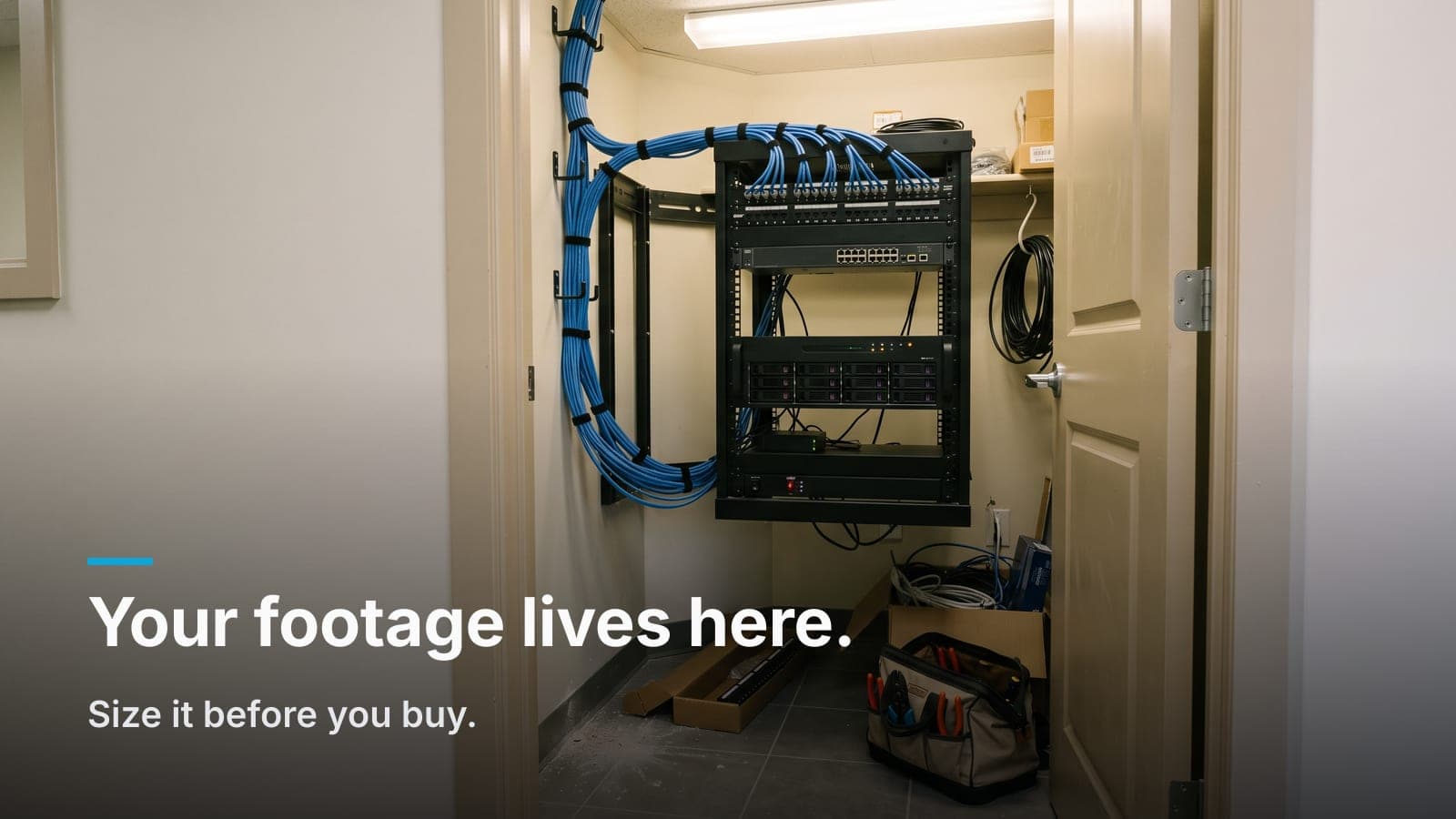
No on-site recording hardware to fail. Local recording means drives, and drives die. A good integrator sizes them right and you swap them on a schedule, but it's a maintenance item. With a cloud-first platform, your on-site failure domain is the camera and the switch. For a business with no IT staff and no interest in getting any, that's a legitimate reason to pay someone to own the problem.
Feature velocity. Cloud vendors ship new analytics constantly — occupancy counts, tailgating detection, cross-camera person search, alert workflows tied into other systems. Ubiquiti ships features too, and has gotten noticeably faster, but the enterprise cloud players are further ahead on the fancy stuff.
Enterprise procurement fit. Some organizations would rather have an operating expense with a support SLA than a capital purchase with an integrator's warranty behind it. If your CFO thinks in OpEx and your risk team wants a vendor to point at, the subscription model fits the org chart. That's a real consideration, not a silly one.
What ownership does better
Here's the other side, and it's why the majority of what I install in the Treasure Valley is UniFi.
The cost curve doesn't bend against you
A per-camera monthly or annual license is a fine trade when you have five cameras. It's a different conversation at twenty-four, and a different one again in year six. The math nobody puts on the first quote: your license bill is the same in year eight as year one, and by then you've paid for the hardware several times over — and you still don't own it. Add a camera to a warehouse aisle and you've added a permanent line item to your operating budget.
Owned hardware is the opposite shape. You spend real money up front, then the ongoing cost is drives, the occasional PoE switch, and service calls. I've laid out how those upfront numbers actually break down in what commercial camera installation really costs in Boise — the punchline is that on most SMB systems the entire install lands in the range of a few years of subscription fees on the same camera count.
It keeps working when the business gets tight
This is the one that decides it for a lot of owners once they think it through. Cash gets tight, a renewal gets missed, a location closes, the credit card on file expires while your office manager is on leave — with a licensed platform, your security system's usefulness depends on an active billing relationship. With local recording, the cameras record whether or not anybody has logged in this quarter. Remote viewing through Ubiquiti's app is included at no charge, but even if you never touched the internet again, the footage is sitting on a drive in your closet.
No vendor lock-in, and no ransom on your own footage
If you get unhappy with a cloud vendor, your options are limited: the cameras are usually proprietary to that platform, so switching means replacing hardware. If you get unhappy with your UniFi integrator — including me — the system is yours. Another integrator can take it over tomorrow. I think that's how it should work. You paid for it.
There's a related point about the footage itself. When a claim, a theft, or a termination dispute comes up, you want the recording under your roof, exportable by your staff, without a support ticket or a retention-window surprise. Local-first storage makes that boring, and boring is good.
Bandwidth and the buildings we actually work in
Plenty of Treasure Valley warehouses, shops, and churches are on internet that would charitably be called adequate. Continuous cloud upload from a couple dozen cameras is real sustained bandwidth, and on a 20 Mbps up connection shared with VoIP and point-of-sale, that's a problem. Local recording sends almost nothing upstream until someone asks for a clip. On a warehouse with wide coverage needs — and warehouses need more cameras than people expect, which I broke down in how many cameras a warehouse actually needs — that bandwidth difference stops being theoretical fast.
One ecosystem, one contractor
Because UniFi covers the switching, the Wi-Fi, and the cameras, one system design serves all of it. Your cameras get PoE from switches that are already managed in the same app, VLANs are set up once by the person who understands both halves, and when a camera drops offline nobody argues about whether it's a network problem or a camera problem. That's less about brand loyalty than about eliminating the finger-pointing seam that shows up when the camera vendor and the network vendor are different companies.
Where UniFi Protect is honestly weaker
A review that doesn't cover the shortcomings isn't a review.
- Multi-site is fine, not great. You can view multiple consoles from one account and one app, and for three or four sites that's genuinely workable. For twenty sites with rotating staff and centralized user management, a cloud platform is better and I'll say so.
- User management is basic. Roles and permissions exist, but if you need per-camera, per-user, per-time-window access with an exportable audit log, you'll find Protect thin.
- Support is a different animal. Ubiquiti's model is community-plus-forums, not a 24/7 enterprise TAC line. In practice that means your integrator is your support, so pick one who answers the phone. On the flip side, you're not paying for a support org you'll call twice a decade.
- Camera line breadth. Ubiquiti's catalog covers most commercial needs well now — turrets, bullets, domes, PTZs, fisheyes, LPR, viewports, doorbells and intercoms. But if you need something specialized like explosion-proof housings, thermal, or exotic optics, Axis and a few others still own that territory and I'd spec them.
- It's not a life-safety or regulated-alarm platform. Cameras record; they don't dispatch. If you have monitoring or compliance requirements, they get designed separately.
A simple way to decide
Answer these four:
- How many sites? One to five, ownership. Ten-plus, take the cloud demo seriously.
- Who administers it? An office manager or facilities lead who wants a simple app leans owned. A real IT/security team that will use granular controls leans cloud.
- Does anyone audit you? If a regulator or insurer asks for access logs and enforced retention, that's a point for the subscription platforms.
- Where does the money hurt more? If a capital purchase is impossible but a monthly line item is fine, the subscription is doing something useful for you. If you'd rather spend once and be done, own it.
Most of the businesses I walk through in Boise, Meridian, and Nampa — a 12,000 sq ft warehouse, a dental office, a two-location retailer, a church campus — land on ownership, because they're one or two sites with lean staff who want good footage, a simple app, and no recurring bill. That's not a coincidence; it's the profile the model fits. If you're the twenty-site org, I'd rather tell you honestly that the cloud platform fits better than sell you something you'll outgrow.
Whatever platform ends up on the drawing, the parts that decide whether the system is any good are the same either way: camera placement that covers the doors, aisles, and cash points that actually matter; enough resolution at the distance you're viewing from; clean Cat6 with proper terminations and a labeled rack; adequate PoE headroom; and someone who came out and looked at the building before quoting it. A great camera in the wrong spot is worse than a mediocre one aimed correctly.
Frequently asked questions
Do I need a subscription for remote viewing on UniFi Protect?
No. Remote access through the UniFi app and web portal is included with the hardware at no ongoing charge. You do need a reasonable internet connection at the site, and the account holding the console should have MFA turned on.
How long can UniFi Protect keep footage?
It depends on drive capacity, camera count, resolution, and framerate — not on a license tier. Thirty days is a common target for commercial sites, and I size the drives to hit whatever retention window you tell me you need, with headroom for cameras you add later.
Can UniFi cameras work with an existing non-Ubiquiti network?
Yes, though it's less clean. Protect cameras need a UniFi console (a Dream Machine, NVR, or similar) and PoE, and they'll run on third-party switches. You just lose the single-app visibility and some of the troubleshooting convenience that makes the ecosystem worth choosing in the first place.
Can I mix cloud cameras and owned cameras in one building?
You can, and occasionally it makes sense — for instance keeping an existing licensed system in a regulated area while covering the warehouse with owned hardware. Just budget for two apps, two support paths, and clear documentation about which cameras record where.
What about older analog or DVR cameras — can those be reused?
Sometimes the coax runs can be reused with converters, but the honest answer is usually no. Analog resolution rarely satisfies anyone who's seen modern footage, and if we're already pulling new cable to most camera positions, the savings from reuse tend to evaporate. I'll tell you on the walk which existing infrastructure is worth keeping. More on how we approach that on our security camera page.
If you want a straight answer for your building — including "you'd be better off with the other kind of system" — request a site walk and a fixed quote and I'll come look at it.